A full breakdown of the agreement and what it represents and signifies.
by Kenechukwu Okonkwo Esq.
The Nigerian Maritime Administration and Safety Agency (NIMASA) and the Nigerian Navy recently renewed their strategic partnership through a five year Memorandum of Understanding (MoU) aimed at strengthening maritime safety, security, and enforcement within Nigeria’s maritime domain. This continues a great and strategic relationship/partnership that was kick-started/began in 2007 and from time to time periodically reviewed.
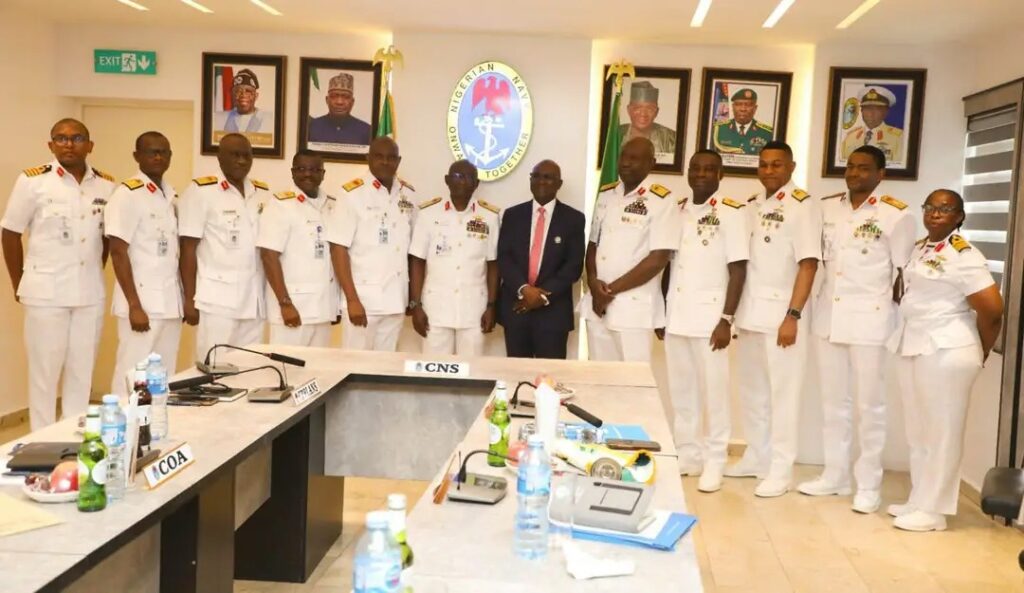
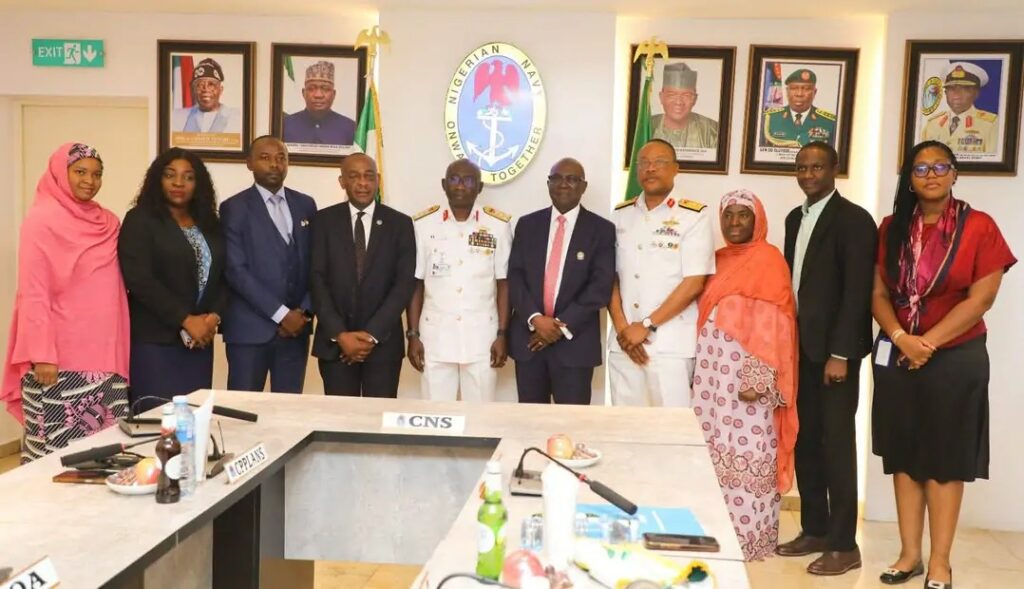
The MoU was signed at the Nigerian Navy Headquarters, Abuja, by the Director General of NIMASA, Dr Dayo Mobereola, and the Chief of Naval Staff, Vice Admiral Idi Abbas.
Background and purpose of the MoU
The MoU exists because NIMASA and the Nigerian Navy have different but complementary statutory roles.
NIMASA’s role:
NIMASA was established under the NIMASA Act 2007 and is responsible for: Maritime administration and regulation, Maritime safety standards, Shipping development, Cabotage enforcement, Pollution prevention, Seafarers’ welfare and certification, Maritime security coordination etc.
However, NIMASA is a civilian regulatory agency and does not possess armed enforcement powers.
Nigerian Navy’s role:
The Nigerian Navy derives its authority from: The 1999 Constitution of the Federal Republic of Nigeria (as amended), The Armed Forces Act, and Other maritime security laws.
Its functions include: Protection of Nigeria’s territorial waters, Maritime defence, Enforcement support, Prevention of illegal activities at sea.
The MoU therefore creates a framework where:
NIMASA provides regulatory, financial and technical support, while the Navy provides operational capability, security and enforcement support.
This arrangement has been central to maritime security initiatives, including the Deep Blue Project. The deep Blue Project officially known as the Integrated National Security and Waterways Protection Infrastructure, is Nigeria’s comprehensive maritime security architecture. Launched on June 10, 2021, it aims to secure Nigerian territorial waters and the wider Gulf of Guinea against piracy, sea robbery and illegal activities.
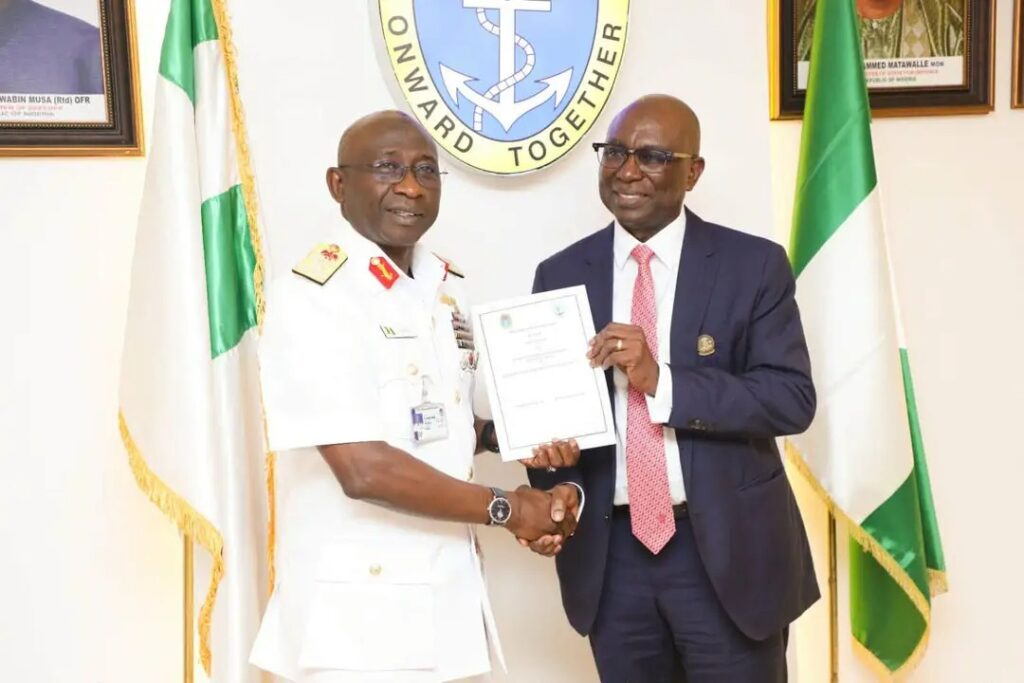
This MoU agreement provides a platform/framework for the enhanced collaboration in the promotion and maintenance of maritime security and the effective implementation of the Suppression of Piracy and Other Maritime Offences (SPOMO) Act, the International Ship and Port Facility Security (ISPS) Code and also other relevant maritime laws and regulations within NIMASA’s mandate.
At the signing ceremony, the director General of NIMASA, Dr Dayo Mobereola, commended and appreciated the commitment and efforts of the Honourable Minister of Marine and Blue Economy, Adegboyega Oyetola, in strengthening inter-agency collaboration, a key driver of maritime security and the development of Nigeria’s Blue Economy.
He further buttressed that the renewal of the MoU would provide a stronger institutional framework for both organisations to discharge their respective statutory mandates and duties while still consolidating the gains already recorded in securing Nigeria’s maritime domain. This he said would be the driving force that will enhance and facilitate the achievement of the goals of President Bola Ahmed Tinubu for the Blue Economy.
He also further stated that the agreement is also designed and projected to address emerging maritime security challenges through improved coordination, information sharing and operational cooperation.
“As we renew this partnership today, I urge our respective teams to ensure that the spirit of this agreement translates into practical and measurable outcomes”
Dr Mobereola said.
Dr Mobereola also expressed appreciation and gratitude to the Chief of the Naval Staff and the Nigerian Navy for their continued support and commitment to the renewal of their partnership.
The Chief of the Naval Staff, Vice Admiral Idi Abbass, in his remarks described the signing as a milestone in the enduring relationship between the Nigerian Navy and NIMASA.
He further opined that the renewed MoU contained important additions aimed at strengthening the response to the evolving nature of maritime security challenges. One of the key provisions as he stated is the integration of the Deep Blue Project into the collaborative framework, providing a stronger basis for cooperation between the Nigerian Navy’s Maritime Guard Command and the project.
He also noted and highlighted the introduction of a joint reporting protocol for communication and information sharing during operations, which he said would facilitate timely decision-making and a more coordinated response to the maritime incidents.
The Vice Admiral, Idi Abbass further welcomed provisions for greater institutional engagement, including an annual conference to enhance collaboration, review progress and address emerging challenges.
“Whether we like it or not, the water is where we get whatever we are getting – our revenue, everything and even the trade we engage in, in large percentages, is done through the water. So this institution has to be very strong”
Idi Abbass said.
The renewed MoU is expected to deepen operational cooperation between NIMASA and the Nigerian Navy, particularly in maritime security, information sharing, coordinated responses to maritime incidents, enforcement of applicable maritime laws amongst others.
Legal Effect of the MoU
A key point from a legal perspective is that MoU is generally not the same as an Act of Parliament or a treaty. It is primarily an administrative agreement establishing cooperation between institutions.
Its legal effects include:
(a) Creation of mutual obligations
Both parties undertake responsibilities toward achieving agreed objectives.
For example:
NIMASA may provide resources and regulatory support; Navy provides operational security assistance.
(b) No transfer of statutory powers
The MoU does not transfer NIMASA’s statutory functions to the Navy or vice versa.
The Navy remains governed by military laws, while NIMASA remains governed by its enabling legislation.
(c) Operational framework
It provides procedures for cooperation, such as: Who coordinates activities, How information is shared, How joint operations are conducted, etc.
Effect on Nigeria’s Blue Economy
The MoU supports Nigeria’s Blue Economy agenda by creating a safer environment for: Shipping, Offshore activities, Fishing, Maritime investment, and Port-related businesses.
A secure maritime domain encourages: Foreign investment, Lower insurance risks, increased confidence among ship-owners, Greater commercial activity.
Effect on Nigerian Ship-owners and Maritime Businesses
For indigenous operators, the MoU may result in: Reduced piracy risks, Safer shipping routes, Better enforcement against illegal competition, and increased confidence in Nigerian waters
Conclusion and Overall Assessment.
The renewed NIMASA–Nigerian Navy MoU represents a civil-military maritime security partnership designed to solve a structural problem:
NIMASA has regulatory authority but lacks armed enforcement capability, while the Navy has security capability but does not regulate commercial maritime activities.
By combining these strengths, the MoU creates a more integrated maritime governance system.
Its practical effects are expected to be: Stronger maritime security, better enforcement of shipping regulations, improved protection of vessels and seafarers, Support for Nigeria’s Blue Economy, and Increased investor confidence in Nigerian waters.
In essence, the MoU is not merely a security agreement; it is a strategic maritime governance instrument aimed at making Nigeria’s maritime domain safer, more investable, and more commercially productive.
SOURCES:
- NIMASA’s official Facebook page and website.
- The Sun Nigeria
- The Guardian Nigeria
- Nigeria Maritime News- dailytrend.com.ng
More Like This

MARITIME: THE HIDDEN WORLD THAT MOVES THE PLANET.
An Introduction to the Vast Universe of Maritime Affairs, Its Branches, Opportunities, and Global Importance by Kenechukwu Okonkwo Esq. ...
Read Article
PAPSS: Africa’s Answer to Seamless Intra-African Payments?
Imagine a trader in Lagos selling goods to a buyer in Dakar, and the payment gets settled in seconds, no need to convert...
Read Article